
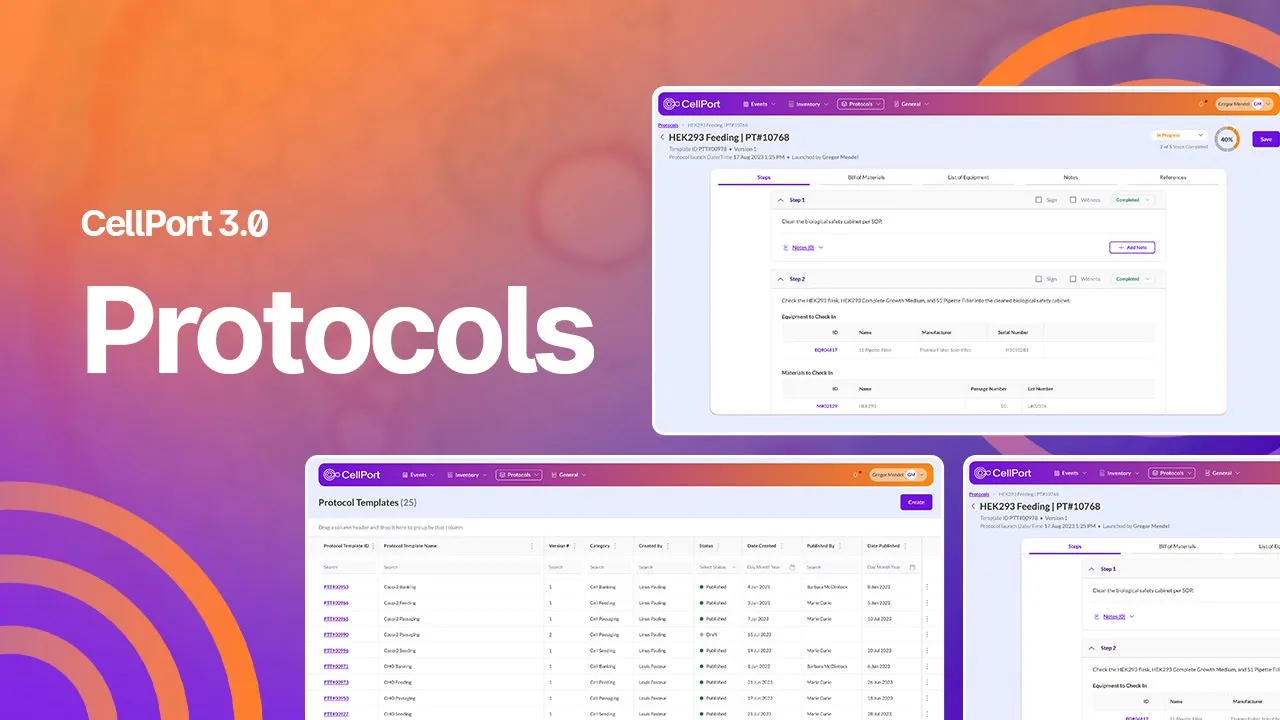


In 2023, CellPort Software came to JWC with a product the market had never properly met. The company had been building quietly since 2014 — a SaaS platform purpose-built for cell-manufacturing and cell-banking labs, developed and tested inside real scientific environments. The product worked. The scientific substance was there. What was missing was a go-to-market motion that could translate any of it into pipeline.
CellPort was preparing to launch commercially into a space dominated by legacy vendors and regulated by serious compliance requirements — FDA, GMP, GLP, Master Batch Records. Their buyers would be sophisticated: CROs, CMOs, biopharma companies, research institutions, lab directors, C-suite operators. Every one of them would ask the same unspoken question before the first demo: who are these people, and can I trust them with my lab?
This was a full Growth Stack engagement — a product that had been built in the lab now needed to be built for the market.


As we worked through discovery, leadership interviews, and competitive positioning sessions with the CellPort team, JWC ran its Tension System process and revealed the paradox at the center of the brand. Two, seemingly opposite ideas needed to be true at the same time.
CellPort needed to be seen as both authoritative and innovative — a paradox in a regulated industry that is wary of unproven tools. Labs that manage compliance-critical work don’t reward experimentation. They reward track record, certainty, and names they already trust. But CellPort’s actual differentiation was genuinely new work: the only full LIMS purpose-built for cell-manufacturing environments, created by the scientists who had worked inside those labs themselves.
They had to signal the authority of an established vendor and the innovation of a purpose-built challenger — at the same time, in a market that instinctively treats those two things as opposites.



Discovery revealed something specific. Competitors in the space were general-purpose LIMS platforms retrofitted for cell work — adequate, but not built for the environment. CellPort was the opposite. It was the only full LIMS purpose-built for cell-manufacturing, created by the scientists who had worked inside those labs themselves. The team didn’t need to imagine their user. The team was their user.
That insight resolved the paradox. Authority didn’t have to come from legacy name recognition — it came from the people behind the product. And innovation wasn’t a risk to be defended — it was the inevitable result of scientists finally building the tool they had always needed. The story became specific: built by the scientists who needed it. That insight became the input to every layer that followed.


This was a full-stack engagement. Each layer of the Growth Stack produced the inputs to the next.
Strategic Foundations
The work started with Strategic Foundations. The ICP Spectrum System defined who CellPort was actually built to serve — lab directors and scientists in cell-manufacturing environments, C-suite operators at CROs and CMOs, procurement leads at biopharma and research institutions, and regulated government research agencies. The Positioning System resolved what CellPort was in the market: not a general-purpose LIMS adapted for cell work, not a generic life sciences platform. The only full LIMS purpose-built for cell-manufacturing environments — designed and developed by the scientists who needed it themselves. The Market Focus System sequenced the launch — which buyer categories to prioritize first and which to build toward later.
Brand Foundations
That positioning decision became the input to Brand Foundations. The Core Idea System resolved the authority-vs-awareness tension into a brand posture CellPort would come to call the authoritative upstart — established in substance, modern in posture. The Messaging System structured how the idea scaled across contexts, from the homepage headline to the investor deck to the cold outreach email. The Written Identity System defined the voice: cut through the noise, not add to it; use language that communicates quality, simplicity, and performance; avoid jargon and puns; speak to scientists the way the scientists behind the product would speak. The Visual Identity System gave CellPort a presence that matched the posture — clean, technical, modern, confidence-forward.
Marketing Foundations
With the brand in place, we moved into Marketing Foundations. The Customer Journey System mapped how each ICP would move from awareness to retention — awareness content for cold prospects who had never heard of the brand, authority content for technical buyers evaluating the category, conversion content for leads deep in the funnel. The Channel Role System defined what each channel was for: the website as the authoritative technical destination, email for lead nurture and white paper delivery, LinkedIn for boosting reach and retargeting warm traffic, Google Ads for search capture, cold outbound for direct access to target accounts.
Growth Engine
Finally, the Growth Engine. The Content System turned the positioning into an ongoing pipeline — flagship white papers as authority assets, blogs and microblogs as SEO and nurture content, demo videos for conversion, and sales enablement materials to support the downstream sales motion. The Campaign System built repeatable campaign structures around each major content drop so every white paper, every blog, every demo video deployed across multiple channels from a single source. A targeted outbound motion was built to reach named accounts directly, giving CellPort a way to surface the brand with buyers who would otherwise never have encountered it. Weekly marketing leadership meetings, rolling marketing reports, and prospecting briefs kept the engine operating with the cadence of an in-house team.
Within months of launch, the engine was producing real pipeline. Targeted outbound contributed a meaningful share of total leads during the months it was running. White paper releases drove significant traffic spikes on launch. The content library began building domain authority in a space where the CellPort name had previously been invisible.


CellPort arrived.
Before the engagement, the company had a product and a small circle of customers who knew it existed. After the engagement, CellPort had a full market presence — a brand that signaled authority, a website that matched the product’s technical substance, a content library competitors had to reckon with, a targeted outbound motion generating real leads, and a demand generation system their sales team could operate inside.
The downstream effect was felt across the business. Sales conversations started further up the trust curve because the brand had already done the introduction. Leads arrived pre-educated by the content. The team had a repeatable go-to-market motion rather than a series of one-off efforts.
CellPort went from a decade-old product the market had never met to a commercial brand with a real launch behind it. The work that had happened quietly in the lab could finally be seen.
Next projects.
(2016-25©)